
Is Rust Proofing a Car Worth It?
If you plan to keep your car for more than a few years, rust proofing a car can absolutely be worth it. The underside of a vehicle is constantly exposed to water, road salt, mud and contamination, and once corrosion begins to take hold, dealing with the damage can become considerably more involved than protecting the vehicle in the first place.
That does not mean every car needs the same treatment, though.
The right approach to car rust proofing depends on the age and condition of the vehicle, how often it is driven, where it is stored and how long you intend to keep it.
For a daily-driven car, annual protection may be perfectly suitable. For a valuable classic, performance car or long-term keeper, investing in a more comprehensive corrosion protection system can make much more sense.
Why do cars rust?
Rust forms when iron or steel reacts with oxygen and moisture. On a vehicle, the underside is particularly vulnerable because it spends its life facing the road.
Water, salt, mud and road debris can collect around wheel arches, suspension components, chassis sections, seams and other difficult-to-clean areas.
This is particularly relevant during the British winter. Road salt helps keep roads safe in freezing conditions, but it is not particularly kind to exposed metal.
Over time, corrosion can progress from relatively superficial surface rust into deterioration that affects components and structural areas of the vehicle.
Why road salt speeds corrosion up
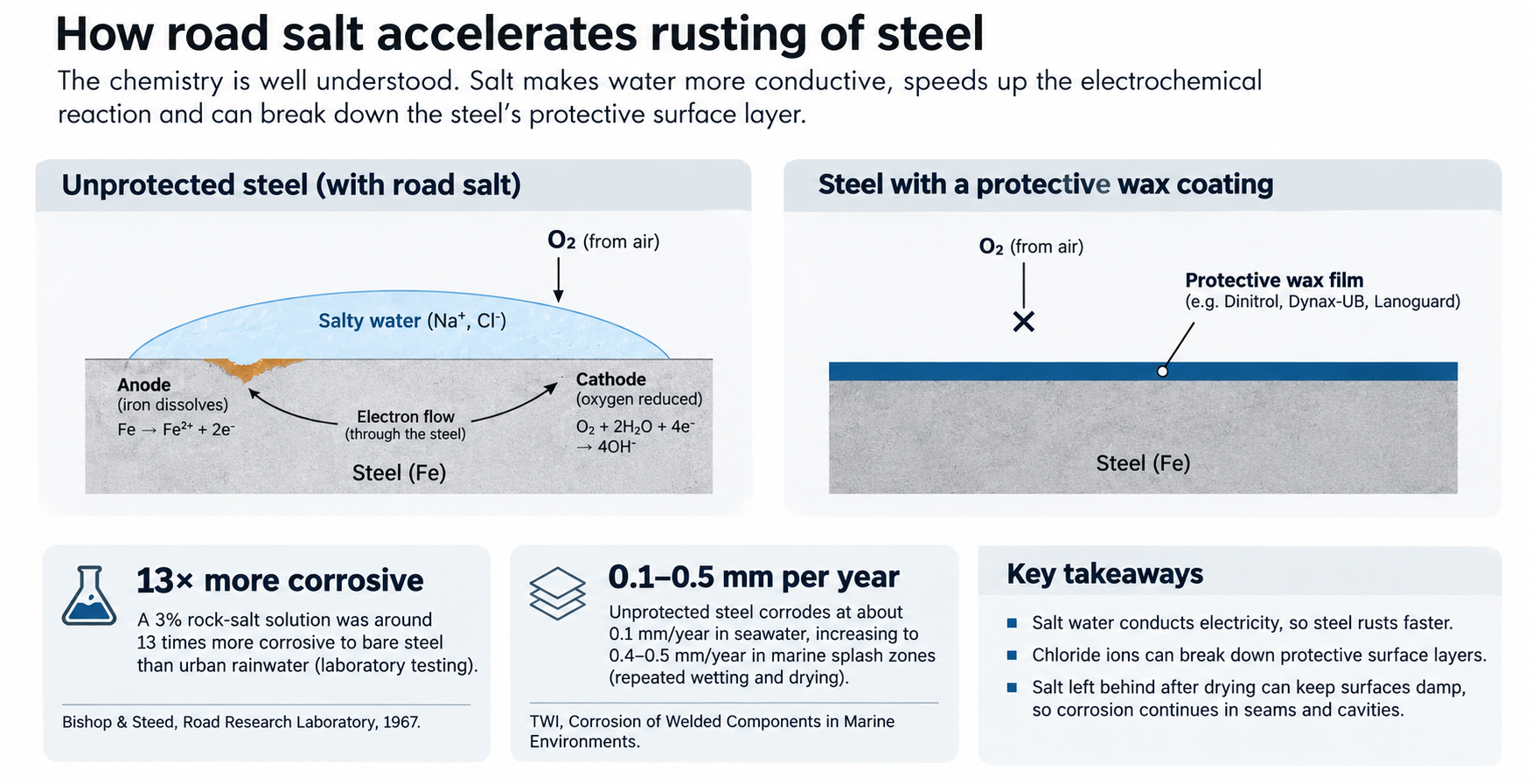
Rust is an electrochemical reaction, and it relies on water to carry an electrical current across the surface of the steel. Dissolved salt makes that water far more conductive, so the reaction runs faster.
Salt does more than that. The chlorides it contains can disrupt the thin protective layers that form on metal surfaces, and salt deposits attract and hold moisture, keeping seams, joints and cavities damp long after the road has dried. That is why winter road salt raises the corrosion risk so sharply, and why coastal and marine environments add further exposure.
The effect has been measured. In laboratory testing, the British Road Research Laboratory found that a 3% rock salt solution was approximately 13 times more corrosive to bare steel than urban rainwater under the conditions tested. That does not mean a car will rust 13 times faster on the road. Real-world corrosion depends on the vehicle, its coatings and how it is used and stored. It does show how strongly salt can accelerate the corrosion of exposed steel.
Marine exposure tells a similar story. TWI gives indicative corrosion rates for unprotected carbon steel of approximately 0.1 mm per year when continuously immersed in seawater, rising to 0.4 to 0.5 mm per year in aggressive marine splash zones. These figures are not predictions for how quickly an individual vehicle chassis will corrode. They demonstrate how significantly exposure conditions can influence corrosion.
Salt exposure in Cornwall
In Cornwall, salt exposure is not limited to winter gritting. Coastal air and sea spray bring salt all year round, on top of the salty road spray thrown up through the winter months.
That spray works its way into seams, chassis rails, wheel arches and box sections. Thin sheet metal is especially vulnerable, and over time progressive metal loss can lead to perforation.
4x4s used to launch boats and jet skis face more again. A slipway can put saltwater directly onto chassis sections, welds, brakes and suspension components, and trailers may be immersed in seawater time after time.
Corrosion you cannot see
Not all corrosion is visible from underneath. It can develop out of sight inside hollow chassis sections, box sections, sills and other enclosed areas, where moisture and salt collect and the metal is rarely seen.
By the time it shows on the outside, it may have been working from the inside for some time. That is why cavity protection can be an important part of a comprehensive rust protection treatment, alongside the coating applied to the visible underside.
What are the benefits of rust proofing?
The biggest benefit of rust proofing is prevention.
A properly prepared and protected underbody has an additional barrier between vulnerable surfaces and the environment around them. This can help slow corrosion and preserve the condition of the vehicle underneath.
For owners of classic, specialist and performance vehicles, there is another consideration: preservation.
Keeping original metalwork, chassis components and factory finishes in good condition can be preferable to repairing or replacing them once corrosion has become established.
Effective vehicle rust protection can therefore help:
- Protect vulnerable metalwork from moisture and road salt
- Slow the development of corrosion
- Preserve original components and surfaces
- Reduce the likelihood of more substantial corrosion repairs later
- Maintain the condition of a classic or specialist vehicle
- Protect a car you intend to own for the long term
But there is an important distinction between simply applying an underseal and carrying out a proper corrosion protection programme.
Preparation matters as much as the rust proofing product
One of the biggest mistakes with underbody protection is focusing entirely on the coating.
A corrosion protection product is only one part of the process.
Before applying protection, you need to understand what is already underneath the vehicle. Road film, salt, grease, mud, ageing underseal and existing corrosion can all be present.
Simply covering everything can make it harder to assess what is happening underneath.
At Sublime Precision, we use dry ice blasting to thoroughly decontaminate vehicle underbodies before protection where appropriate.
The process removes compacted contamination, salt, road film and loose or deteriorating coatings without introducing water or abrasive blasting media, while generally preserving sound factory underseal and finishes where appropriate. This leaves a clean, dry surface that can be properly inspected before the next stage begins.
Where complete removal of existing underseal is needed, that is a separate service and is quoted separately.
It also means the protection is being applied to a properly prepared substrate rather than simply covering years of contamination.
Is rust proofing worth it on a new car?
It can be.
Rust proofing is not only something to consider once corrosion has appeared. In many cases, prevention is the better approach.
If you have bought a vehicle you intend to keep for many years, adding protection while the underside is still in excellent condition can help preserve it.
This can be particularly relevant for specialist vehicles, 4x4s, performance cars and vehicles that will see regular year-round use.
The question is less about whether the vehicle is new and more about your plans for it.
If it is a short-term ownership proposition, extensive long-term protection may not be necessary. If you are buying something you intend to keep, preserve or eventually pass on, the calculation changes considerably.
Is rust proofing an older car worth it?
Again, potentially, but the condition of the car needs to be assessed first.
Applying rust protection does not magically reverse existing corrosion.
An older vehicle should therefore be properly inspected and prepared before a protective system is applied.
This is another reason why underbody cleaning is valuable. Removing years of accumulated grime and deteriorating coatings exposes the actual condition of the vehicle underneath.
You can then make an informed decision about what needs addressing before protection is applied.
For classic vehicles in particular, that inspection can be just as important as the final coating.
Can you rust proof over existing rust?
Sometimes, but only once you know exactly what you are dealing with. Our approach is:
- Clean and inspect the underside.
- Assess the extent and condition of any existing corrosion.
- Treat suitable, accessible surface corrosion with rust converter where appropriate.
- Allow the treatment to cure correctly.
- Apply the selected protection system afterwards.
Serious or structural corrosion cannot simply be converted and coated over. If we find significant corrosion, we work with our fabrication partner, No Rust for the Wicked in Crowlas, to carry out the necessary repairs before any protection is applied.
Corrosion and the MOT
Significant structural corrosion can also affect a vehicle’s MOT. The MOT inspection manual treats load-bearing structure within 30 cm of the mounting points for components such as the suspension, steering and brakes as a prescribed area. Within these areas, corrosion that has caused a hole in the metal, or has weakened it so that it no longer feels firm when pressed, is a reason for failure. Outside them, corrosion can still lead to a failure if it significantly reduces the strength of the structure or affects the braking or steering.
How long does car rust proofing last?
It depends entirely on the system.
There is no single answer because different products are designed for different applications and maintenance intervals.
At Sublime Precision, we offer four levels of underbody corrosion protection:
Lanoguard Clear
A transparent, shorter-term treatment suited to vehicles in active use or stored outdoors. Annual top-up for exposed areas.
Bilt Hamber Dynax-UB
A wax-based underbody protection system and a practical option for daily-use classics and weekend cars. Annual inspection, with top-ups every 1 to 2 years in exposed areas.
Dinitrol Full System
A comprehensive professional corrosion protection system suited to owners looking for longer-term preservation. Around five years of protection, maintained by annual inspection and top-ups.
Ceramic Underbody Coating
Our longest-lasting option, maintained by annual inspection. Intended for high-value vehicles where long-term preservation is the priority.
Protection periods are indicative and depend on vehicle use, exposure, preparation and ongoing maintenance. We recommend annual inspections for all systems, with localised top-ups or repairs where required. Actual service life may vary, and these figures do not constitute a warranty.
There is no universally ‘best’ option. The right system depends on the vehicle.
For a closer look at each system, read what is the best underbody rust protection for a car, or see how two of them compare in Dinitrol vs Lanoguard.
Looking after the protection
Whichever system is applied, a little aftercare goes a long way. We recommend:
- A gentle freshwater rinse after significant saltwater exposure, such as launching a boat
- A freshwater rinse after heavy winter road-salt exposure, where practical
- An annual inspection of the protection system
- Localised repairs or top-ups wherever chips, wear or damage are identified
Appropriate maintenance can help prolong the effectiveness of the protection system.
When is rust proofing most worthwhile?
Rust proofing becomes particularly compelling when you own a vehicle that you care about preserving.
That could include:
- Classic and collector cars
- Performance vehicles
- Land Rover Defenders and other 4x4s
- Vehicles driven throughout winter
- Cars stored outdoors
- Recently restored vehicles
- Low-mileage examples you want to preserve
- Vehicles you intend to own for many years
A Porsche 911 being prepared for long-term preservation has very different requirements from a daily-driven classic that spends every winter on the road.
The treatment should reflect that.
So, is rust proofing a car worth it?
For many owners, yes.
If the vehicle is worth preserving and you intend to keep it, protecting vulnerable areas before serious corrosion develops is generally preferable to dealing with deterioration later.
But the quality of the process matters.
Good rust protection starts with understanding the condition of the vehicle, thoroughly preparing the underside and then selecting a system appropriate to the way the car is actually going to be used.
At Sublime Precision, we do not lead with one product. We assess the vehicle, its condition, storage and intended use before recommending the appropriate protection system.
- Bishop and Steed, Road Research Laboratory (1967). Corrosion inhibitors as additives to highway de-icing salts: laboratory tests
- TWI (2003). Corrosion of welded components in marine environments
- DVSA. MOT inspection manual, Appendix A: structural integrity and corrosion
Enquire about professional rust proofing
Sublime Precision provides specialist underbody cleaning and corrosion protection for classic, performance, high-value and specialist vehicles from our facility at Guildford Road Industrial Estate, Hayle, Cornwall.
Vehicles can be brought directly to us, or nationwide concierge collection and return can be arranged through our dedicated transport partner.
If you are considering rust proofing your vehicle, request a vehicle assessment and we can discuss its condition, how you use it and the level of protection that makes sense.
A real quote, usually within 24 hours. No obligation.

