
Dinitrol vs Lanoguard: Which Is Right for Your Vehicle?
If you are researching corrosion protection for your car, Dinitrol vs Lanoguard is a comparison you are likely to come across.
Both are designed to help protect vehicles against corrosion, but they are not identical products and, more importantly, they suit different approaches to vehicle preservation.
At Sublime Precision, we offer both.
We do not consider one universally better than the other. For us, the decision comes down to the vehicle, how it is used, where it is stored and how long the owner wants the protection to last.
What is Lanoguard?
Lanoguard is a lanolin-based corrosion protection treatment that creates a flexible barrier across the vehicle’s underbody.
Lanolin is a naturally occurring waxy substance, extracted from sheep’s wool during processing. It is what helps wool repel water, and that same moisture resistance makes it a useful basis for a flexible protective coating on a vehicle.
Some lanolin-based treatments carry a distinctive woolly, ‘wet sheep’ smell, particularly when freshly applied.
Its transparent finish allows the underlying surfaces to remain visible, which can be useful for ongoing inspection.
Lanoguard states that its underbody treatment displaces moisture and creates a flexible protective barrier against salt, grit and moisture. It is designed to be suitable for a wide range of materials around a vehicle’s underside.
It is also designed around straightforward periodic reapplication rather than being treated as a permanent coating.
At Sublime Precision, we recommend Lanoguard Clear as approximately a one-year protection system, with an annual top-up for exposed areas.
What is Dinitrol?
Dinitrol is an established vehicle corrosion protection range incorporating products designed for different areas of a vehicle, including the underbody and internal cavities.
Dinitrol’s UK range includes dedicated underbody corrosion protection, cavity protection and rust-treatment products.
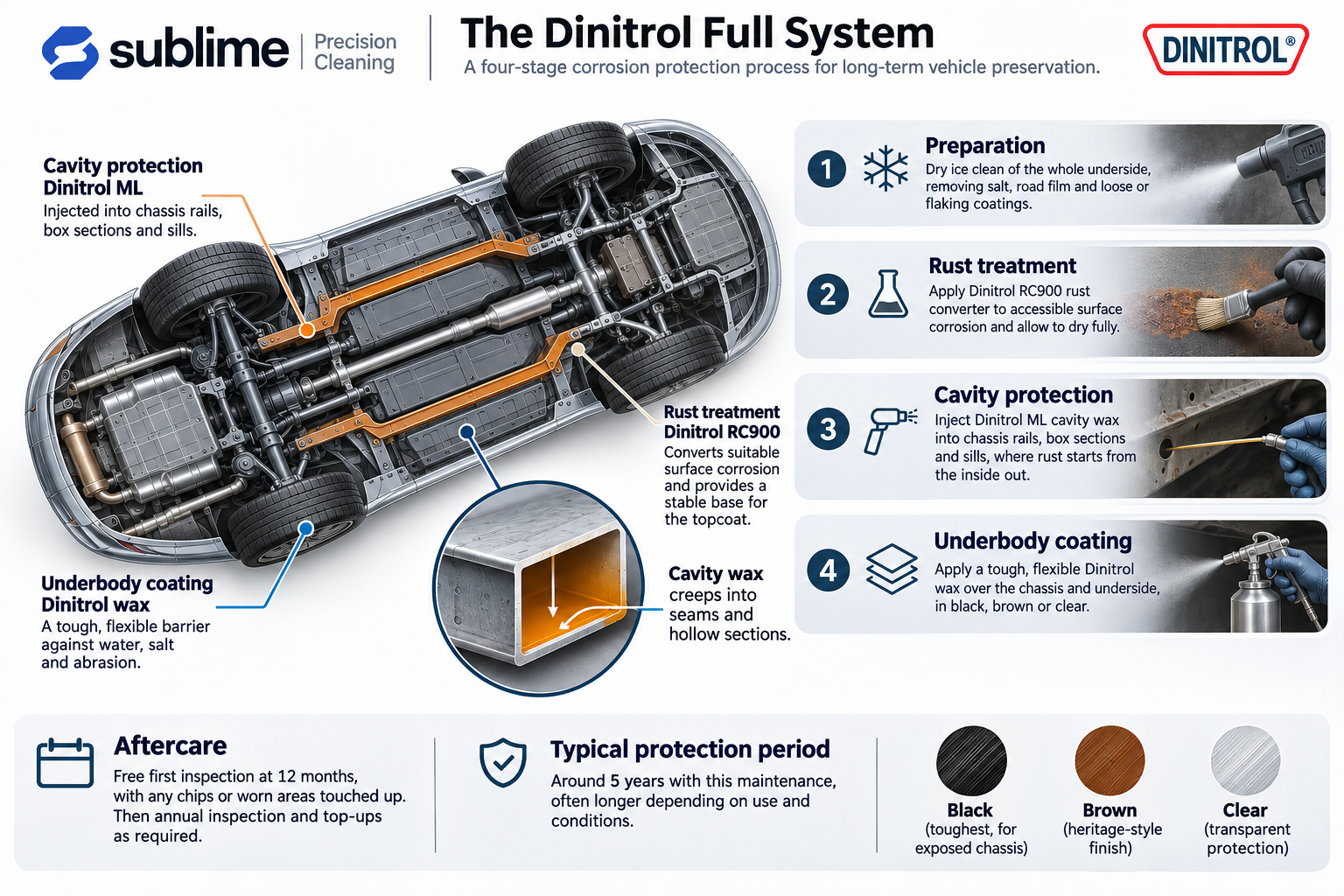
At Sublime Precision, we offer it as a full professional Dinitrol system rather than simply applying one general-purpose coating to the underside of the car.
The complete system typically provides around five years of protection, subject to annual inspection and maintenance.
It therefore occupies a different position in our corrosion protection range from Lanoguard.
It is worth separating two things here. An individual Dinitrol underbody wax performs a broadly similar fundamental role to Lanoguard, creating a flexible barrier against moisture and salt. Our Full Dinitrol System is a more comprehensive four-stage process.
Stage 1: Preparation
We dry ice clean the underside to remove road film, grease, contamination and loose or deteriorating coatings. Sound factory finishes are preserved where appropriate.
Stage 2: Rust treatment
Where suitable, accessible surface corrosion is present, we apply Dinitrol RC900 rust converter and allow it to cure fully before any further protection is applied. Not every vehicle needs this stage, and it is only carried out where it is required.
Stage 3: Cavity protection
Dinitrol ML cavity wax is injected into chassis rails, box sections, sills and other enclosed areas using a flexible injection lance. The wax creeps into seams and hidden spaces, where corrosion can develop without being visible from the outside.
Stage 4: Underbody coating
A tough, flexible Dinitrol protective wax is then applied to the underbody using a professional spray gun. Available finishes can include black, brown or clear, depending on the vehicle and the Dinitrol product selected.
Dinitrol aftercare
Every Full Dinitrol System includes:
- A free first inspection after 12 months
- Localised touch-ups to chips or worn areas where required
- Annual inspections thereafter
- Additional top-ups as required
With that care, the system typically provides around five years of protection, and potentially longer. In practice this depends on vehicle use, environmental exposure, preparation, annual inspection, ongoing maintenance and any localised repairs and top-ups. Five years is a guide, not a guarantee or warranty.
Dinitrol vs Lanoguard at a glance
| Lanoguard Clear | Dinitrol Full System | |
|---|---|---|
| Type | Lanolin-based protection | Multi-product corrosion protection system |
| Finish | Transparent | Black, brown or clear, depending on the product |
| Our recommended interval | Around 1 year | Typically around five years, subject to annual inspection and maintenance |
| Maintenance | Annual top-up for exposed areas | Free first inspection at 12 months, followed by annual inspections and top-ups as required |
| Typical use | Active-use and outdoor vehicles | Longer-term preservation |
| Approach | Flexible, regularly renewed protection | Comprehensive professional system |
| What’s included | Underbody protection | Preparation, rust treatment where required, cavity protection and underbody coating |
Protection periods are indicative and depend on vehicle use, exposure, preparation and ongoing maintenance. We recommend annual inspections for all systems, with localised top-ups or repairs where required. Actual service life may vary, and these figures do not constitute a warranty.
The key difference is not simply the chemistry. It is how the two systems fit into the ownership and maintenance of the vehicle.
When does Lanoguard make more sense?
Lanoguard can be an excellent choice when you want straightforward corrosion protection that becomes part of the vehicle’s annual maintenance.
We particularly consider it for vehicles in active use or those stored outdoors.
Because it is transparent, the condition underneath also remains visible, rather than being obscured by a thick coating.
For an owner who is comfortable having the vehicle inspected and the protection reapplied each year, that can be a very sensible approach.
It may therefore suit:
- Regularly driven vehicles
- Cars stored outside
- Owners who prefer annual inspection and maintenance
- Vehicles where visible underlying surfaces are desirable
When does Dinitrol make more sense?
The Dinitrol treatment becomes particularly attractive when the goal is longer-term preservation.
Rather than planning around annual reapplication, the full Dinitrol system provides a more extensive corrosion protection programme with a considerably longer recommended interval.
That can make it more appropriate for:
- Classic vehicles
- Long-term keepers
- Restoration projects
- High-value cars
- Owners wanting a longer maintenance interval
- Vehicles where internal cavity protection forms part of the preservation strategy
If you have spent significant time and money restoring a vehicle, for example, a comprehensive system designed around longer-term preservation may be more appropriate than a treatment intended for annual renewal.
Is Dinitrol better than Lanoguard?
Not necessarily.
It depends on what ‘better’ means for your vehicle.
If you want longer-term protection and a comprehensive professional preservation programme, we would be more likely to discuss Dinitrol.
If you want transparent protection that can be renewed as part of an annual maintenance schedule, Lanoguard may be the better fit.
There are also circumstances where neither would be our first recommendation.
Sublime Precision also offers Bilt Hamber Dynax-UB, a wax-based option with annual inspection and top-ups every 1 to 2 years in exposed areas, and ceramic underbody coating, our longest-lasting option, maintained by annual inspection. All four are compared in what is the best underbody rust protection for a car?
The advantage of having several systems available is that we do not have to force every vehicle into the same solution.
Whichever you choose, preparation comes first
There is little point comparing corrosion protection products without discussing what they are being applied to.
The condition of the substrate matters.
An underbody can accumulate years of salt, mud, oil, road film and old coatings. Applying fresh protection directly over that contamination is not how we approach preservation.
At Sublime Precision, dry ice blasting allows us to remove underbody contamination without introducing water, chemicals or abrasive blasting media.
The process removes loose and deteriorating coatings while generally preserving sound factory underseal and finishes where appropriate. Complete removal of existing underseal is a separate service and is quoted separately.
That gives us the opportunity to properly assess the condition of the vehicle before protection is applied.
Once clean, the underbody is ready for the protection system selected for that particular car.
What if the vehicle already has rust?
Neither Dinitrol nor Lanoguard should be treated as a way of simply hiding corrosion.
Existing rust needs to be assessed first.
Minor surface corrosion and more significant deterioration are very different situations, and the appropriate preparation needs to reflect what is actually present.
For an older vehicle, removing years of contamination before deciding on the final treatment can therefore be one of the most valuable parts of the process.
It turns rust proofing from a cosmetic exercise into a genuine vehicle preservation programme. For more on when protection pays off, see is rust proofing a car worth it?
Dinitrol vs Lanoguard: the verdict
When you want flexible, renewable protection
Transparent corrosion protection that can be inspected and renewed annually.
When you want longer-term preservation
A more comprehensive programme, typically providing around five years of protection, subject to annual inspection and maintenance.
But do not choose purely from a comparison table.
A classic Land Rover driven through winter, a restored Jaguar E-Type and a low-mileage Porsche stored in a climate-controlled garage all present completely different requirements.
The right answer starts with the car.
Discuss the right treatment for your vehicle
Sublime Precision provides professional underbody preparation and corrosion protection for classic, performance, specialist and high-value vehicles from our automotive facility at Guildford Road Industrial Estate, Hayle, Cornwall.
We offer Lanoguard, Bilt Hamber Dynax-UB, the full Dinitrol system and ceramic underbody coating, allowing the treatment to be selected around the vehicle rather than the other way around.
Nationwide concierge vehicle collection and return is also available.
Request a vehicle assessment and tell us what you drive, how you use it and what you want to achieve. We can then recommend the appropriate preparation and corrosion protection system.
A real quote, usually within 24 hours. No obligation.

